


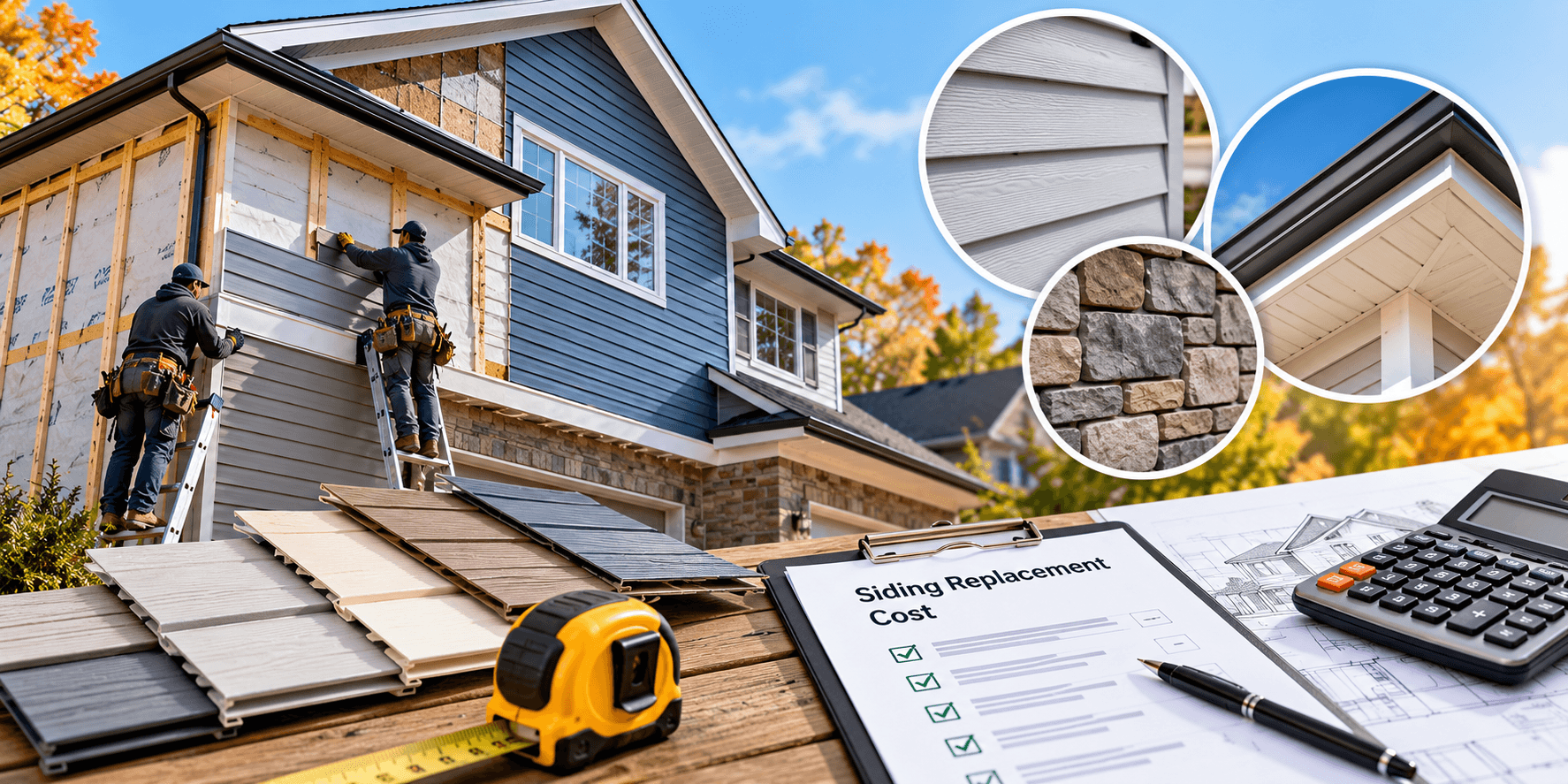
Replacing your home’s siding is one of the most effective ways to boost curb appeal, improve energy efficiency, and protect your house from Ontario’s demanding weather. It’s also a significant investment, and the first question most homeowners ask is a fair one: how much is this going to cost? The honest answer is that it depends, because no two homes or projects are exactly alike.
To help you plan with confidence, this guide breaks down realistic siding replacement cost ranges in Ontario, compares the main materials, and explains the factors that move your final number up or down. By the end, you’ll know what to budget for and what to ask when you request a quote.
Average Siding Replacement Cost in Ontario
Siding is priced by the square foot of wall area, not your home’s floor space, and the material you choose is the biggest driver of cost. Here are typical installed price ranges in Ontario for 2026, covering materials and labour for the siding itself:
| Siding material | Installed cost (CAD / sq ft) |
|---|---|
| Standard vinyl | ~$6 – $9 |
| Insulated vinyl | ~$9 – $12 |
| Aluminum | ~$8 – $12 |
| Engineered wood | ~$9 – $14 |
| Fibre cement (James Hardie) | ~$12 – $18 |
| Steel / metal | ~$12 – $18 |
Ranges reflect Ontario pricing for 2025–2026 and cover the siding material and its installation. They exclude tear-off of old siding, trim, soffit, fascia, eavestrough, and any repairs. Actual pricing varies by home and project.
For a standard vinyl re-side, which is the most budget-friendly choice, approximate project totals by home size (field siding only) look like this:
- Bungalow: roughly $9,700 – $14,600
- Two-storey home: roughly $13,200 – $19,800
- Larger or complex two-storey: roughly $15,100 – $22,700
Premium materials like fibre cement or steel can push a larger home’s project well above these figures. To weigh the options side by side, our guide to vinyl vs. James Hardie vs. wood is a helpful starting point.
Factors That Affect Your Siding Replacement Cost
Two homes on the same street can get very different quotes. These are the factors that shape your budget.
1. The siding material
As the table shows, material is the single biggest variable. Vinyl is the most affordable and low-maintenance, aluminum sits in the middle, and James Hardie fiber cement and steel are premium options with higher upfront cost and long lifespans.
2. Home size and wall area
More wall area means more material and labour. Remember that wall area, not floor area, determines the cost, so a two-storey home generally has more to cover than a bungalow of the same footprint.
3. Removing and disposing of old siding
A replacement includes tearing off the existing cladding. Removal and disposal typically add around $1 to $3 per square foot, and more when a new moisture barrier (house wrap) and flashing go on at the same time, often bundled as a prep allowance of a few dollars per square foot.
4. Home shape, height, and access
Lots of corners, peaks, gables, and dormers add cutting and trim work, and taller or hard-to-reach homes need more scaffolding and time. A simple, boxy home costs less per square foot than a complex, multi-level one.
5. Trim, soffit, fascia, and eavestrough
Siding projects often involve more than the walls. Updating soffit and fascia or eavestroughs at the same time adds to the total but gives a cleaner, finished result, and it’s often more efficient to do it all at once.
6. Hidden repairs
Once the old siding is off, crews sometimes find damaged sheathing, rot, or a failed moisture barrier underneath. Repairing these issues protects your home but can add to the cost, which is why a good contractor explains how such findings are handled before work begins.
7. Labour and timing
Skilled installation is worth paying for, since a poor install can lead to leaks and premature failure. Busy seasons can also affect scheduling and pricing, so planning ahead helps.
What’s Usually Included in a Siding Quote?
When comparing quotes, make sure you’re comparing the same scope. A clear, itemized estimate should spell out:
- Materials: the siding plus trim, corners, and fasteners
- Labour: preparation and installation
- Tear-off and disposal of the old siding
- House wrap and flashing, where included
- Any extras like soffit, fascia, and eavestrough
A quote that only says “siding installed” can look cheaper until the extras appear later. If you’re considering a budget-friendly refresh, our aluminum siding installation guide is worth a read, and the vinyl siding option remains the most popular for cost-conscious homeowners.
How to Get an Accurate Estimate
Online ranges are a planning tool, not a final price. For numbers you can rely on:
- Get a written, itemized quote based on measured wall area
- Confirm the exact material and grade being quoted
- Ask what’s included and what counts as an extra
- Check that the company is insured and experienced with Ontario homes
- Ask how unexpected repairs are priced
Most importantly, choose experienced siding contractors who stand behind their work. The right crew makes the difference between siding that lasts for decades and a project you’ll be fixing in a few years.
Why Choose Ontario Siding & Gutters
Ontario Siding & Gutters provides professional siding installation and replacement across Richmond Hill, Woodbridge, Maple, Newmarket, King City, and Aurora. From vinyl and aluminum to James Hardie fibre cement and metal, the team helps you choose the right material for your home and budget, and installs it to last.
If you’re ready for a real number on your project, the siding contractors in Richmond Hill at Ontario Siding & Gutters can measure your home and provide a clear, itemized quote with no surprises.
Get a Free Siding Replacement Quote
Find out exactly what your siding project will cost. Ontario Siding & Gutters serves Richmond Hill and surrounding communities with expert siding replacement.
330 Hwy 7, Unit 305, Richmond Hill, ON L4B 3P8
Frequently Asked Questions
How much does siding replacement cost in Ontario?
It depends mainly on the material and your home’s size. Installed costs typically range from about $6 to $9 per square foot for standard vinyl up to roughly $12 to $18 for fibre cement or steel. A standard vinyl re-side on an average home often lands in the low-to-mid five figures, before tear-off and extras.
Which siding material is the most affordable?
Vinyl is generally the most budget-friendly option, offering durability and low maintenance at the lowest cost per square foot. Aluminum is a mid-range choice, while fibre cement and steel sit at the premium end with longer lifespans.
Does the price include removing the old siding?
Not always. Base installation ranges usually cover the new siding and labour. Tearing off and disposing of the old siding typically adds around $1 to $3 per square foot, more if a new moisture barrier and flashing are added. Always confirm what your quote includes.
Why are the quotes I’m getting so different?
Differences usually come down to material, scope, and what’s included. One quote may cover tear-off, house wrap, and trim while another covers siding only. Compare itemized quotes with the same material and scope to judge them fairly.
How do I get an accurate price for my home?
The only way to know your real cost is a site visit and a written, itemized quote based on measured wall area. Ontario Siding & Gutters can assess your home and provide a clear estimate for your siding replacement.